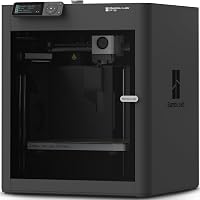
Bambu Lab A1 FDM 3D Printer, 256 x 256 x 256 mm Build Volume, Full-Auto Calibration, Active Flow Rate Compensation
Reviewed by RateThePick Editorial Team · Updated
The Bambu Lab A1 is a full-size, open-frame FDM 3D printer. FDM means it builds objects by melting plastic filament and laying it down layer by layer. It is designed to take much of the fiddly setup out of home 3D printing. It handles bed probing and motion calibration automatically and adjusts extrusion on the fly. It also connects to Bambu's MakerWorld model library, so beginners can find a model and start a print with prepared settings. With a 256 mm cube build volume and an entry-level position in Bambu's lineup, it aims to give new and returning hobbyists fast, clean PLA and PETG prints without hours of tuning.
- Full-auto calibration handles bed probing and vibration tuning, with no manual leveling
- Active flow rate compensation adjusts extrusion using a nozzle pressure sensor
- Roomy 256 x 256 x 256 mm build volume for a bed-slinger in this class
As an Amazon Associate we earn from qualifying purchases.
Best For
Adult beginners and hobbyists who want a capable, full-size printer that calibrates itself. It also suits people moving up from older manual-leveling machines who are tired of constant tuning, and makers who print mostly PLA, PETG and TPU and want quick, good-looking results. The A1 also makes sense for anyone who may add multicolor printing later through Bambu's optional AMS accessories.
Things to Consider
- Bambu does not recommend ABS, ASA, PC, nylon or fiber-reinforced filaments for this printer
- The moving bed needs extra clearance front to back on your desk
Score Breakdown
Why We Like It
What Buyers Notice
Public owner discussions often come back to how easy the A1 is compared with older printers. Owners switching from older Ender-style machines describe easier calibration, faster prints and the convenience of sending MakerWorld models from their phone. Speed is a recurring point of praise. In one long-term ownership discussion, several owners report thousands of print hours with routine care such as regular lubrication. Some owners mention that the first layer and bed adhesion still benefit from a clean plate and occasional screw checks. Feedback on noise varies: some find it relatively quiet, while others notice the motors more than they expected.
Who Should Buy It
Buy the Bambu Lab A1 if you want a full-size 3D printer that calibrates itself, prints PLA and PETG quickly and cleanly, and lets you start projects straight from the MakerWorld library. It is a strong pick for adult first-time buyers and for owners upgrading from older manual-leveling machines. If you mainly plan to print ABS, ASA or engineering filaments, look at an enclosed printer instead.
Detailed Review
The Bambu Lab A1 (model PF002-A) is the full-size member of Bambu's entry-level A1 series. It is not the smaller A1 mini. It is an open-frame Cartesian printer with a bed that moves forward and back, a direct-drive extruder and a 256 x 256 x 256 mm build volume. The frame combines steel and extruded aluminum. It uses an all-metal hotend and hardened-steel extruder gears, and the printer weighs 8.3 kg.
Setup and automation
Bambu describes assembly as taking under an hour. After that, much of the traditional fine-tuning is automatic. The nozzle probes the plate to find its distance from the surface, and calibration routines address vibration and extrusion behavior. Bambu's active flow rate compensation uses an eddy-current sensor to measure nozzle pressure. In plain terms, it detects changes in how much melted plastic is coming out and corrects for them, particularly at corners. Automation cuts down setup work, but a clean build plate and basic maintenance such as lubrication still matter.
Print quality and speed
Launch-era reviewers tested the A1, in some cases in its Combo configuration, and came away impressed. Tom's Hardware printed a speed Benchy in about 19 minutes with mostly smooth layers and a crisp bow, and its PETG test printed cleanly. TechRadar measured a mean combined X/Y dimensional error of 0.099 mm on its test pieces. Tech Advisor noted clean walls and good clearances on articulated parts. The toolhead is rated up to 500 mm/s with 10,000 mm/s² acceleration. These figures are ceilings, though: default slicer speeds in testing were typically 200 to 300 mm/s, and real print times depend on the model and material.
Materials
Bambu recommends PLA, PETG, TPU and PVA. It advises against ABS, ASA, PC, PA, PET and carbon- or glass-fiber-reinforced filaments. The hotend reaches 300°C and the bed 100°C, and the printer takes standard 1.75 mm filament with a built-in cutter. It works with Textured PEI, Smooth PEI/High Temperature and Cool Plate build surfaces.
Everyday use
- 3.5-inch color touchscreen, plus control through the Bambu Handy app and Bambu Studio on Windows or macOS
- Low-frame-rate camera for monitoring and timelapses
- Filament runout, tangle detection and power-loss recovery
- 2.4 GHz Wi-Fi and microSD; Bambu also describes a LAN mode that works without an account or internet connection
- Bambu rates noise at under 48 dB in Silent mode
Room to grow
The optional AMS lite adds four filament feeds for multicolor printing through a single nozzle. Each color change purges the previous filament, which adds time and some waste. A firmware update in October 2025 also added support for Bambu's original AMS, AMS 2 Pro and AMS HT through an A1-series hub. These are separate purchases, not part of the printer itself.
Good to know
Bambu's safety guidelines say the A1 should be used indoors in a dry, ventilated room at 15 to 30°C, on a stable, level surface. The guidelines also say it should not be used by children. In June 2024, the CPSC announced a recall of early A1 units sold between December 2023 and January 2024 over a heatbed cable issue; affected units have an "A" in the sixth position of the serial number. Bambu later said a separate AC-board component issue on older machines was resolved by a redesign in Q3 2025. Owners can check their serial number and follow Bambu's guidance if in doubt.
Verdict: For adult beginners and PLA/PETG hobbyists, the A1 combines a generous build volume, genuinely hands-off calibration and polished software. That makes it one of the easiest ways to get into full-size 3D printing.
FAQ
Is the Bambu Lab A1 the same as the A1 mini?
No. The A1 is the full-size model with a 256 x 256 x 256 mm build volume. The A1 mini is a separate, smaller printer with a 180 mm cube build area.
What filaments can the A1 print?
Bambu recommends PLA, PETG, TPU and PVA. It does not recommend ABS, ASA, PC, nylon, PET or carbon- or glass-fiber-reinforced filaments for this printer.
Can I add multicolor printing later?
Yes. The optional AMS lite adds four filament feeds. A later firmware update also added support for other Bambu AMS units through an A1-series hub. These accessories are sold separately.
Does the A1 need an internet connection?
Not necessarily. Bambu describes a LAN mode that works without an account or internet connection, and you can also transfer files on a microSD card. Cloud features such as remote access are separate.
Is the A1 suitable for children to use?
Bambu's official safety guidelines say the A1 should not be used by children and should be kept out of their reach. Treat it as an adult-operated machine.
How quiet is the Bambu Lab A1?
Bambu rates it at under 48 dB in Silent mode. Noise is higher at faster speeds and during startup calibration, and owner impressions vary.