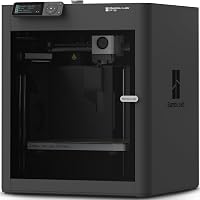
FLASHFORGE Adventurer 5M 3D Printer: CoreXY, Auto Leveling, 280°C Direct Drive Extruder, 220x220x220mm
Reviewed by RateThePick Editorial Team · Updated
The FLASHFORGE Adventurer 5M is an entry-level, open-frame 3D printer built around an all-metal CoreXY frame. CoreXY is a motion layout where the print head moves side to side and front to back while the bed moves down, which helps fast printing. It has a 220 x 220 x 220 mm build volume, a direct-drive extruder that reaches 280°C, automatic bed leveling and a nozzle that can be swapped without tools. The goal is to make quick, everyday PLA and PETG printing simple for people who don't want to spend hours tuning a machine.
- Automatic bed leveling and vibration calibration reduce manual setup
- Fast CoreXY motion; independent tests finished a Benchy in about 26 to 27 minutes
- Quick-release nozzle with optional 0.25, 0.6 and 0.8 mm sizes
As an Amazon Associate we earn from qualifying purchases.
Best For
Beginners and hobbyists who want a fast, mostly automated printer for PLA and PETG parts, toys, organizers and functional prints, and who like the option to send files over Wi-Fi, Ethernet or USB.
Things to Consider
- Open-frame design with no built-in camera or air filtration
- Noticeable fan noise during printing, measured around 62 dB(A) in one review
Score Breakdown
Why We Like It
What Buyers Notice
Owners who have shared their experiences generally describe an easy start, fast prints, usable results and solid value for the money, with several standard 5M owners speaking favorably about the machine and some running more than one unit. A few owners mention that getting a reliable first layer took some attention, and the usual fixes discussed include cleaning the build plate, re-running calibration and using a brim or glue stick. One owner noted it is fairly loud, and another wished it came with a camera and lighting, which are features the 5M Pro adds.
Who Should Buy It
Buy the Adventurer 5M if you want a quick, mostly automated printer for PLA and PETG projects and value speed and simple setup over extras. If enclosed printing, filtration or a built-in camera matter to you, look at the Adventurer 5M Pro instead.
Detailed Review
Design and setup. The Adventurer 5M uses an all-metal CoreXY frame with a single direct-drive extruder, meaning the filament is pushed from right above the nozzle for better control. FLASHFORGE says the printer arrives 95% preassembled and can be set up in about ten minutes. Independent testers reported similar results: one measured 12 minutes of setup, and another's first calibration took about eight minutes. On first startup the printer levels the bed and runs a vibration calibration, which helps reduce ringing, the rippled pattern that fast moves can leave on walls.
Speed in practice. The headline 600 mm/s figure is the maximum travel speed, and the manual lists printing speeds of 10 to 300 mm/s with up to 20,000 mm/s² acceleration. In real tests, a speed-focused Benchy finished in about 26 minutes, while a normal 0.20 mm profile took about 33 minutes. That is quick for an entry-level printer. Reviewers noted that complex shapes can lose a little detail at the highest speeds, so slowing down for display pieces is a good habit.
Print quality. Testers praised dimensional fit and clean support removal, and a clearance test produced working parts with gaps as small as 0.15 mm. One outlet saw some corner distortion, stringing and bridging flaws on default settings and recommended light tuning for the best surfaces. Bed temperature was very even in testing, with only a 2.6°C spread across the plate.
Materials and nozzles. With the installed 0.4 mm nozzle, the printer is aimed at PLA and PETG. Switching to a 0.6 or 0.8 mm nozzle opens up TPU and carbon-fiber-filled PLA and PETG. The two-latch nozzle swap is simple; FLASHFORGE advertises it as a 3-second swap, though you should power off first and re-level afterward. The product page does not list ABS for this open-frame model.
Software and connectivity. Files can be prepared in Flash Studio Desktop (the newer name for Orca-Flashforge), FlashPrint 5 or OrcaSlicer, and the Flash Studio Mobile app handles monitoring. You can print through the cloud, on your local network only, or from a USB stick formatted as FAT32. Video monitoring requires adding an optional camera.
Noise and power. One review measured about 62 dB(A) while printing and 41 dB(A) at idle, with roughly 130 W of draw during PLA printing. It is best placed in a room where some fan noise won't bother you.
Bottom line. The Adventurer 5M is a fast, approachable printer that removes much of the fiddly setup older printers required. It suits everyday PLA and PETG printing well, as long as you're comfortable with an open frame and some fan noise.
FAQ
Is the Adventurer 5M good for a first 3D printer?
It is a solid starting point thanks to automatic leveling, startup calibration and a flexible build plate. Like any printer, expect to learn basic habits such as keeping the plate clean and re-running calibration if first layers struggle.
Does it really print at 600 mm/s?
600 mm/s is the maximum travel speed. The manual lists printing speeds of 10 to 300 mm/s, and real-world tests finished a Benchy boat in about 26 to 33 minutes depending on the profile.
Can I use other brands of filament?
Yes. It accepts 1.75 mm filament from other brands within its supported material types, though you may need to adjust settings for best results.
Does it include a camera?
No. The standard Adventurer 5M does not include a camera; video monitoring requires adding an optional camera. The Adventurer 5M Pro has one built in.
Do I need an internet connection to print?
No. You can send files over your local network only or print from a USB stick formatted as FAT32. Cloud features and the mobile app use an internet connection and an account.
What warranty does it have?
FLASHFORGE's policy lists a 12-month limited printer warranty and three months for extruder parts, with exclusions for consumables and accessories. The quick-start guide also mentions a 400 working-hour limit, and warranty claims are directed through the original seller.